Sandwich panels, self-supporting elements that simultaneously serve as roofing and thermal insulation, are used for:
 |
 |
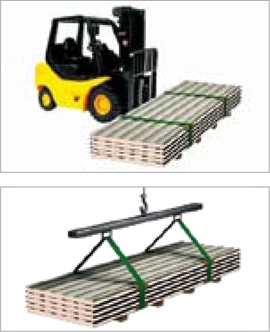
During loading and unloading operations with a forklift, the panels must not be damaged by the forklift blades.
The forklift blades must be positioned equidistant from the center of the bundle.
The panels must be unloaded on site using an appropriate crane with straps. Do not use cables.
Protect the edges of the panels at the strap contact points. A spreader beam is recommended for long panels (see attached photo).
Lift carefully to avoid crushing the panel edges.
Panels must be carried carefully on their sides (see attached photo) to prevent deformation.
Never carry the panels by their interlocking profiles.
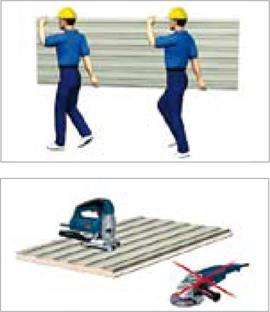
For handling or cutting panels, it is recommended to use an electric jigsaw with steel blades. To achieve a good result, it is necessary to cut along a guide. Metal shavings must be removed immediately.
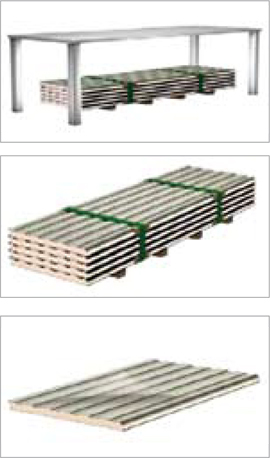
Panels must be stored on a flat surface with a sufficient number of supports (one support every 2 meters).
Panels should be stored with a slight inclination (1% slope) to prevent water accumulation.
It is preferable to store the panels under shelter to protect them from bad weather and splashes.
Panels can be stored in height with a sufficient number of supports placed in the same position on the ground and between the stacks, aligned vertically. Stacked storage must not exceed three bundles (maximum height 2.5 m).
Long-term stacked storage (more than 4 weeks) should be avoided.
The protective adhesive film applied to the panels at the factory must be removed immediately after installation.
Long-term storage of panels with their protective film may damage the coating and make removal impossible.
Sandwich panels, self-supporting elements that simultaneously serve as roofing and thermal insulation, are used for:
|
|
During loading and unloading operations with a forklift, the panels must not be damaged by the forklift blades.
The forklift blades must be positioned equidistant from the center of the bundle.
The panels must be unloaded on site using an appropriate crane with straps. Do not use cables.
Protect the edges of the panels at the strap contact points. A spreader beam is recommended for long panels (see attached photo).
Lift carefully to avoid crushing the panel edges.
Panels must be carried carefully on their sides (see attached photo) to prevent deformation.
Never carry the panels by their interlocking profiles.
For handling or cutting panels, it is recommended to use an electric jigsaw with steel blades. To achieve a good result, it is necessary to cut along a guide. Metal shavings must be removed immediately.
Panels must be stored on a flat surface with a sufficient number of supports (one support every 2 meters).
Panels should be stored with a slight inclination (1% slope) to prevent water accumulation.
It is preferable to store the panels under shelter to protect them from bad weather and splashes.
Panels can be stored in height with a sufficient number of supports placed in the same position on the ground and between the stacks, aligned vertically. Stacked storage must not exceed three bundles (maximum height 2.5 m).
Long-term stacked storage (more than 4 weeks) should be avoided.
The protective adhesive film applied to the panels at the factory must be removed immediately after installation.
Long-term storage of panels with their protective film may damage the coating and make removal impossible.
Rock wool, derived from basalt, is a natural material born from volcanic activity and human expertise. It has unique properties that make it a multi-purpose insulating material:
The density of rock wool ensures remarkable long-term stability; it is non-combustible and maintains its insulating properties even at high temperatures. Rock wool offers the perfect balance that protects against winter cold and summer heat.
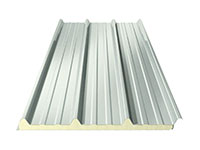
The thermocovering sandwich panels are used in construction of industrial and modular buildings, production workshops, storehouses, shopping centers, sport complexes, school and university buildings and any buildings requiring thermal insulation.
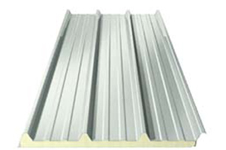
The thermocovering sandwich panel is a selfholding component which performs simultaneously the functions of roofing and thermal insulation. It combines two steel coating facings by means of a rigid polyurethane foam core (PUR) or a rigid polyisocyanurate foam core (PIR)...
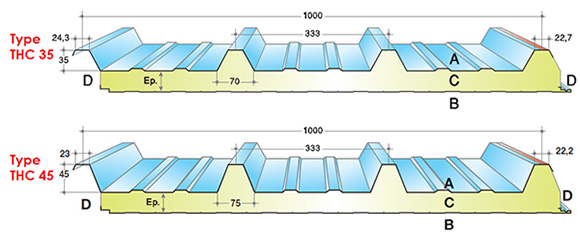
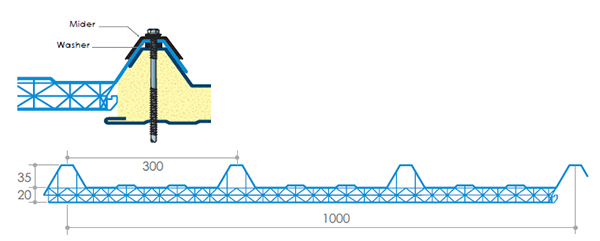
| A | EXTERNAL STEEL SUPPORT | Nervesco profile 3.35.1000T Thickness : 0.4mm – 0.5mm – 0.6mm – 0.7mm Standard: Prepainted galvanized steel support with polyester 25μ top coat- PVDF and Plastisol top coats available on request - Aluminium and Alu Zinc coating steel available on request. |
|---|---|---|
| B | INTERNAL STEEL SUPPORT | Slightly ribbed profile Thickness: 0.4mm – 0.5mm – 0.6mm – 0.7mm Standard: Prepainted galvanized steel support with polyester 25μ top coat- PVDF and Plastisol top coats available on request disponibles sur demande - Aluminium and Alu Zinc coating steel available on request |
| C | INSULATING CORE | Standard: Rigid polyurethane foam (PUR) CFC free applied in continuous between two metal facings. On request : Rigid polyisocyanurate foam (PIR) CFC free Density : 40kg/m³ ± 3kg Thermal conductivity: 0.022W / m.°C Fire classment: Bs3 (Bs2 on request).  |
| D | AIRTIGHTNESS OF LIPS | The THC type comprises a male rib (without foam) and a female rib (with foam) allowing an assembly by means of interlocking. The male and female ribs are sellotaped. The female rib is fitted with an airtight seal. |
| STANDARDS | NF EN10346, NF EN10143, NF EN10169, NF EN13165, NF EN14509, NF EN 13501 -1, Customers specifications. |
30 mm, 40 mm, 50 mm, 60 mm, 80 mm (± 3 mm)
2000 mm à 12000 mm (± 5 mm) – Lengths higher than à 12000 mm available on request
1000 mm (± 5 mm)
- White color – Other colors of the RAL color chart See colors chart.
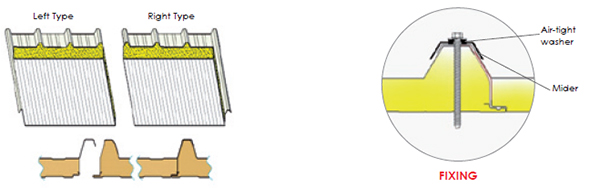
The panels are supplied with a right longitudinal covering and a transverse covering.
A saw line on the external facing at a distance ranging between 80 and 250 mm from the edge could be made at the factory. In this case, it should be specified whether it is the « right » or « left » type, according to the installation required by the direction of the prevailing winds.
A panel is of the right type if the rib of the female longitudinal lip that covers is to the right of the panel when one is standing on the covering and looks at the roof. It is of the left type in opposite way.
The panels could be fixed on steel structure, wood structure or concrete. The fixation would be made with appropriate screw and mider.
ADVANTAGES
Excellent value for money, high thermal insulation, energy saving, panels used for new construction or renovations, quickly and easily mounted.
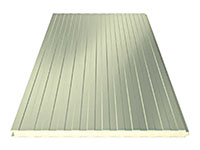
The thermowall sandwich panels are used in construction of industrial buildings, production workshops, storehouses, shopping centers, sport complexes, school and university buildings, cold stores and any buildings requiring thermal insulation.
The thermowall sandwich panel is a self-holding component which performs simultaneously the functions of roofing and thermal insulation. It combines two steel coating facings by means of a rigid polyurethane foam core (PUR) or a rigid polyisocyanurate foam core (PIR).
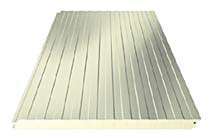
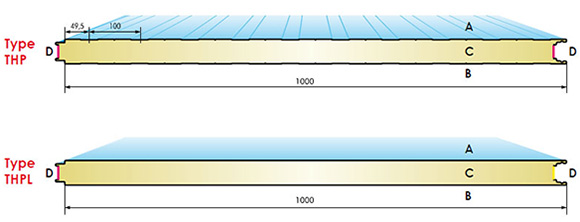
| A | EXTERNAL AND INTERNAL STEEL SUPPORTS | Slightly ribbed profile (THP) or no ribbedness (THPL) Thickness : 0.4 mm – 0.5 mm – 0.6 mm – 0.7 mm Standard: Prepainted galvanized steel supports with polyester 25 μ top coat PVDF and Plastisol top coats available on request - Aluminium, Alu Zinc and Inox coating steel availaible on request. |
|---|---|---|
| B | PAREMENT INTERNE | Slightly ribbed profile (THP) or no ribbedness (THPL) Thickness : 0.4 mm – 0.5 mm – 0.6 mm – 0.7 mm Standard: Prepainted galvanized steel supports with polyester 25 μ top coat PVDF and Plastisol top coats available on request - Aluminium, Alu Zinc and Inox coating steel availaible on request. |
| C | INSULATING CORE | Standard : Rigid polyurethane foam (PUR) CFC free applied in continuous between two metal facings. On request : Rigid polyisocyanurate foam (PIR) CFC free Density : 40kg/m³ ± 3kg Thermal conductivity : 0.022W / m.°C Fire classment : Bs3 (Bs2 on request). |
| D | AIRTHIGHTNESS OF LIPS | The THP and THPL types have a male lip and a female lip allowing an assembly by means of interlocking. The male and female ribs are sellotaped. The THP and THPL types are equiped on the female rib with an airtight joint. |
| STANDARDS | NF EN10346, NF EN10143, NF EN10169, NF EN13165, NF EN14509, NF EN 13501- 1, Customers specifications. |
30 mm, 40 mm, 50 mm,
60 mm, 80 mm (± 3 mm)
2000 mm à 12000 mm (± 5 mm) - Lengths higher than 12000 mm availabe on request.
1000mm (± 5mm)
- White color – Other colors of the RAL color chart See colors chart.
Caractéristiques techniques Caractéristiques techniquesThe thermowall sandwich panels are used in construction of industrial buildings, production workshops, storehouses, shopping centers, sport complexes, school and university buildings, cold stores and any buildings requiring thermal insulation.
The thermowall sandwich panel is a self-holding component which performs simultaneously the functions of roofing and thermal insulation. It combines two steel coating facings by means of a rigid polyurethane foam core (PUR) or a rigid polyisocyanurate foam core (PIR).
The external steel support is a low ribbed profile (14mm) and the internal steel support is a slightly ribbed profile.

Same ribs on external and internal steel supports.
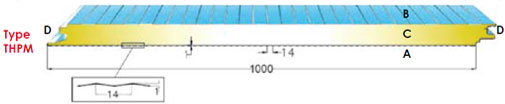
| A | EXTERNAL STEEL SUPPORT | Slightly ribbed profile (THPC) or low ribbed profile (THPM) Thickness : 0.4 mm – 0.5 mm – 0.6 mm – 0.7 mm Standard: Prepainted galvanized steel support with polyester 25μ top coat- PVDF and plastisol top coats available on request Aluminium, Alu Zinc and Inox coating steel available on request. |
|---|---|---|
| B | INTERNAL STEEL SUPPORT | Slightly ribbed profile Thickness : 0.4mm – 0.5mm – 0.6mm – 0.7mm Standard: Prepainted galvanized steel supports with polyester 25μ top coat - PVDF and plastisol top coats available on request - Aluminium, Alu Zinc and Inox coating steel available on request. |
| C | INSULATING CORE | Standard: Rigid polyurethane foam (PUR) CFC free applied in continuous between two metal facings On request: Rigid polyisocyanurate foam (PIR) CFC free Density : 40 kg/m³ ± 3kg. Thermal conductivity : 0.022 W / m.°C Fire classment : Bs3 (Bs2 on request). |
| D | AIRTIGHTNESS OF LIPS | The THPC and THPM types have a male lip and a female lip allowing an assembly by means of interlocking. The male and female ribs are sellotaped. The THPC and THPM types are equiped on the female rib with an airtight joint. |
| STANDARDS | NF EN10346, NF EN10143, NF EN10169, NF EN13165, NF EN14509, NF EN 13501 -1, Customers specifications. |
50 mm, 60 mm, 80 mm (± 3 mm)
2000 mm à 12000 mm (± 5 mm) - Lengths higher than 12000 mm availabe on request.
1000 mm (± 5 mm)
- White color – Other colors of the RAL color chart See colors chart.
Caractéristiques techniques Caractéristiques techniques Nuancier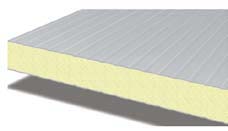
The frigowall sandwich panels are used in construction of cold or air-conditioned wharehouses, cold stores, freezen storage rooms, freezing tunnels and any controlled temperature, humidity or atmosphere buildings.
The frigowall sandwich panel is a self-holding component which performs simultaneously the functions of roofing and thermal insulation. It combines two steel coating facings by means of a rigid polyurethane foam core (PUR) or a rigid polyisocyanurate foam core (PIR).
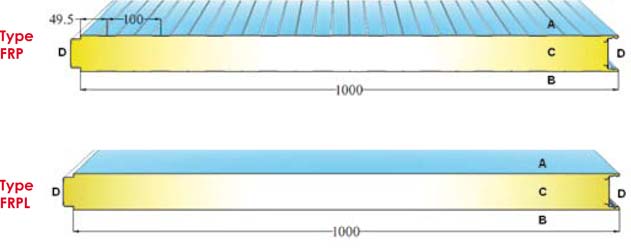
| A | EXTERNAL AND INTERNAL STEEL SUPPORTS | Slightly ribbed profile (FRP) or no ribbedness (FRPL) Thickness : 0.5 mm – 0.6 mm – 0.7 mm Standard : Prepainted galvanized steel supports with polyester 25μ top coat - PVDF and Plastisol top coats available on request - Aluminium, Alu Zinc and Inox coating steel available on request. |
|---|---|---|
| B | EXTERNAL AND INTERNAL STEEL SUPPORTS | Slightly ribbed profile (FRP) or no ribbedness (FRPL) Thickness : 0.5 mm – 0.6 mm – 0.7 mm Standard : Prepainted galvanized steel supports with polyester 25μ top coat - PVDF and Plastisol top coats available on request - Aluminium, Alu Zinc and Inox coating steel available on request. |
| C | INSULATING CORE | Standard : Rigid polyurethane foam (PUR) CFC free applied in continuous between two metal facing. On request : Rigid polyisocyanurate foam (PIR) CFC free Density : 40kg/m³ ± 3kg Thermal conductivity : 0.022W / m.°C Fire classment : Bs3 (Bs2 on request) |
| D | AIRTIGHTNESS OF LIPS | The FRP and FRPL types have a male lip and a female lip allowing an assembly by means of interlocking. The male and female ribs are sellotaped. The FRP and FRPL types are equiped on the female rib with an airtight joint. |
| NORMES | NF EN10346, NF EN10143, NF EN10169, NF EN13165, NF EN14509, NF EN 13501- 1, Customers specifications |
80 mm, 100 mm, 120 mm,150 mm, 180 mm (± 3 mm)
2000 mm à 12000 mm (± 5 mm)
Lengths higher than 12000 mm availabe on request.
1000 mm (± 5 mm)
White color – Other colors of the RAL color chart See colors chart.
APPLICATION
Frigoparoi sandwich panels are intended for the construction of refrigerated or air-conditioned warehouses, cold rooms, refrigerated stores for frozen goods maintenance, and freezing tunnels.
Frigoparoi sandwich panels are intended for the construction of refrigerated or air-conditioned warehouses, cold rooms, refrigerated stores for frozen goods maintenance, and freezing tunnels.
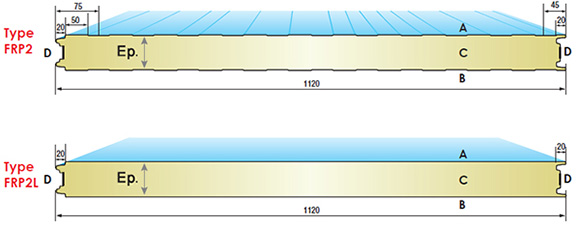
| A B | EXTERNAL COVER | Profile with shallow ribs (FRP2) or completely smooth (FRP2L) Thickness: 0.5 mm - 0.6 mm - 0.7 mm Standard: Pre-painted galvanized steel with 25μ polyester finish -- PVDF and Plastisol available on request - Aluminum, Alu Zinc, and Stainless Steel available on request. |
|---|---|---|
| C | INSULATING CORE | Standard: Rigid CFC-free polyurethane (PUR) foam injected continuously On request: Rigid CFC-free polyisocyanurate (PIR) foam injected continuously Density: 40 kg/m³ ± 3 kg Thermal conductivity: 0.022 W/m. °C Fire rating: Bs3, Bs2 on request. |
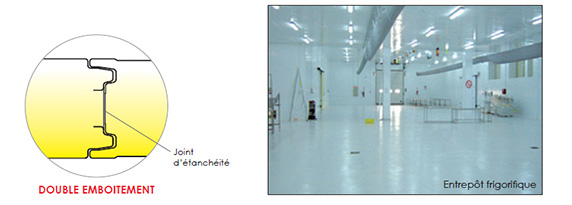
| D | EDGE SEALING | FRP2 and FRP2L types have male and female edges allowing double tongue-and-groove assembly. The male and female ribs are sealed with an adhesive strip. FRP2 and FRP2L types are equipped on the female rib with an air-seal gasket. |
| STANDARDS | NF EN10346, NF EN10143, NF EN10169, NF EN13165, NF EN14509, NF EN13501-1, Customer-specific specifications |
Panel thickness: 80 mm, 100 mm, 120 mm, 150 mm, 180 mm (± 3 mm)
2000 mm to 12000 mm (± 5 mm)
Lengths over 12000 mm available on request
1120 mm (± 5 mm)
White – Other RAL color shades – See color chart
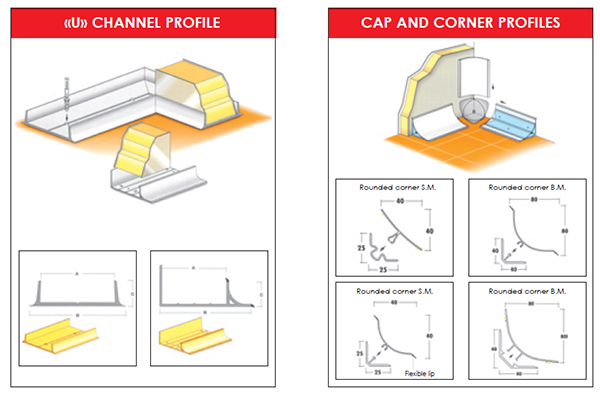
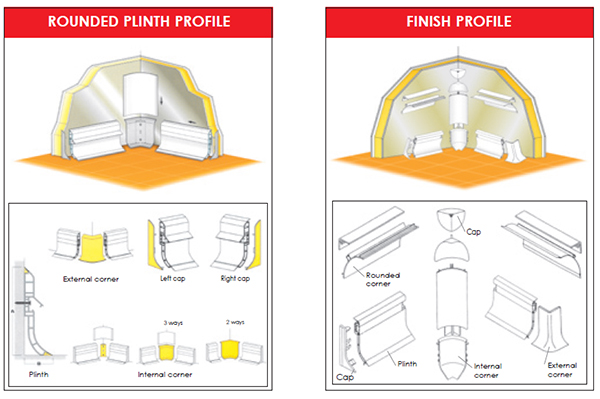
Panels must be fixed to the floor using a floor U-channel. The panels have male and female edges allowing double tongue-and-groove assembly.
During installation, panels must be tightly pressed along the longitudinal side so that the air-seal gasket works properly.
The panels are protected by an adhesive film, to be removed during installation.
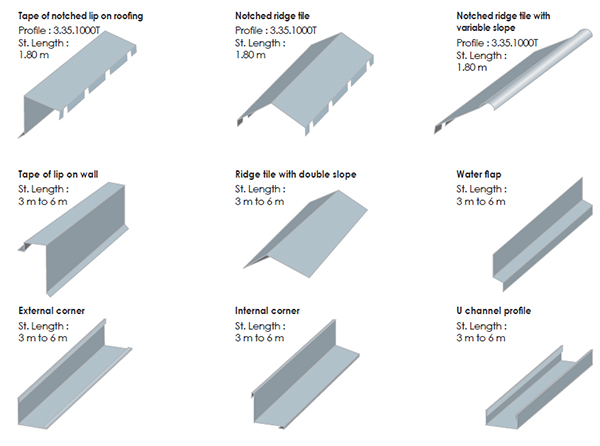
In accordance with our sales department, all elements could be folded on request up to a maximum length of 6 meters according to the customers’ drawings. The price will be defined on the basis of the developed and the number of folds. Gutters on request and according customers’ specifications
If the elements are fixed in continuity, the connections must be sealed either by means of minimum covering or by fishplate junction. Quality sealing is achieved by means of silicone or butyl filters or other adhesives.
The fitting of folded finishing elements is ensured by means of self-tapping or self-drilling screws. The screws for fitting covering elements are equiped with washers.
If the folded finishing elements or profiles have been soiled during the installation, cleaning shoud be made with clear water and soft brush.
Large variety of self- tapping and self-drilling screws for installation . Consult us.
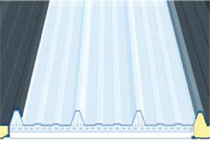
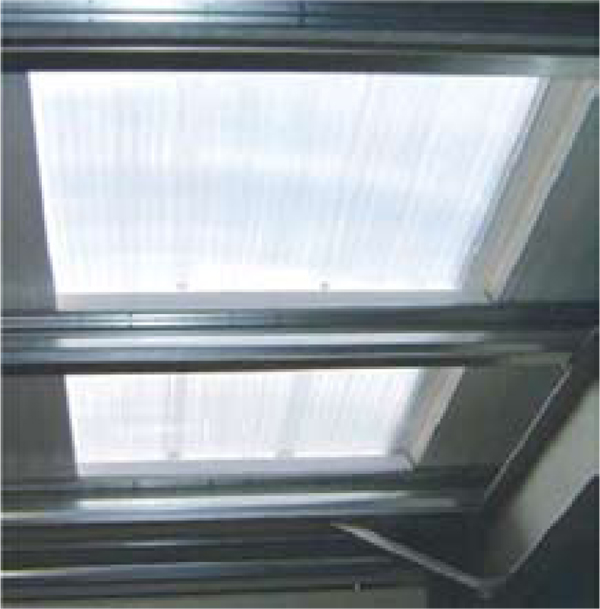
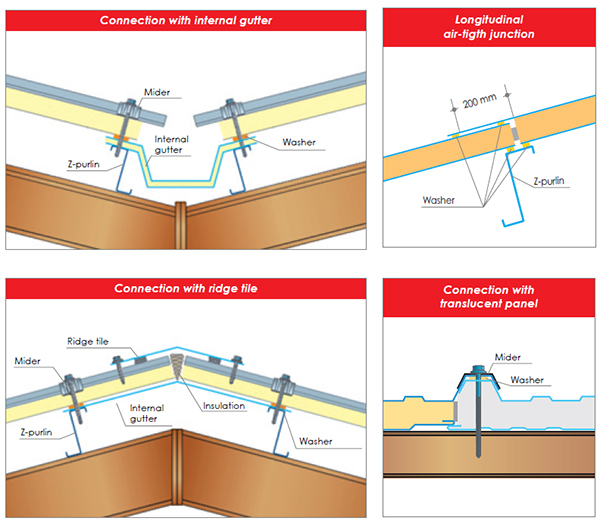
The translucent insulating panels double skin in polycarbonate are used for roofs in connection with our thermocovering sandwich panels THC type.
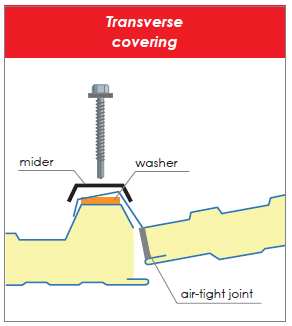
The panels are bound at the top of each rib on the end purlins.
On the middle purlins, binding is made on every two ribs in a shifted way. During installation, the panels should be fastened tightly on the longitudinal part in order to ensure a proper seal of air-tightness joint.
It is recommended to use air-tightness joints with adhesive side on support sides of the panels situated on the end purlins, channels, gutters, side covering, etc.
During loading and unloading operations by forklift, the panels should not be damaged by fork impacts.
There should be an equal distance between each fork and the center of the load in order to avoid unacceptable deflection of panels.
The panels should be unloaded on site by a suitable crane, using strapping. Never use cables.
Protect the edges of the panels at the level of straps. A load distribution apparatus (as shown) should be used for long panels.
Lift carefully to avoid crashing the edges of panels.
Panels must be carried carefully on the side by lifters to avoid bending (as shown).
Never carry the panels by interlocking parts.
In order to cut the panels, always use a whittler. Nerver use disc saws. The burrs and incandescent particules caused from sawing will burn and damage the coating. The filings produced by drilling and other operations, during installation, should be swept away as they might inlay into the coating and cause irreparable damage.
If the panels have been soiled during the installation, cleaning shoud be made with clear water and soft brush.
Panels must be stored in a plane surface on a sufficient number of holds (1 hold every 2 m).
Panels must be stored with a light slope (1 % slope) to avoid water stagnations.
Panels should be kept sloping if there is no closed storage so that the rainwater cannot accumulate.
It is better to store panels under cover to protect them from changing weather and all projections.
Panels could be stored in height over a sufficient number of holds placed in the same place on the ground, between packages and aligned in vertical. The height of the storage does not have to exceed a number of 3 packages (maximum height 2.50 m).
Stacked storage for long periods (more than 4 weeks) must be avoided.
The protective film put on the panel at the factory should be removed immediately after installation and certainly not later than two weeks.
Long term storage of the panels with protective film may damage the coating and it will be impossible to remove the protective film.
Stunas Industries
Founded in 1995, STUNAS INDUSTRIES originally manufactured steel profiles used for dry roofing and cladding of industrial buildings.
Today, STUNAS INDUSTRIES is an innovative industrial company whose main activity is the manufacturing and marketing of sandwich panels for the insulation of refrigerated doors and cold rooms... read more

Headquarters & Plant: BP.1 - Industrial Zone Borj Cédria 2055 Bir El Bey - TUNISIA
Tel.: +216 70 242 450
Fax: +216 71 430 713
E-mail: sales@stunasindustries.com